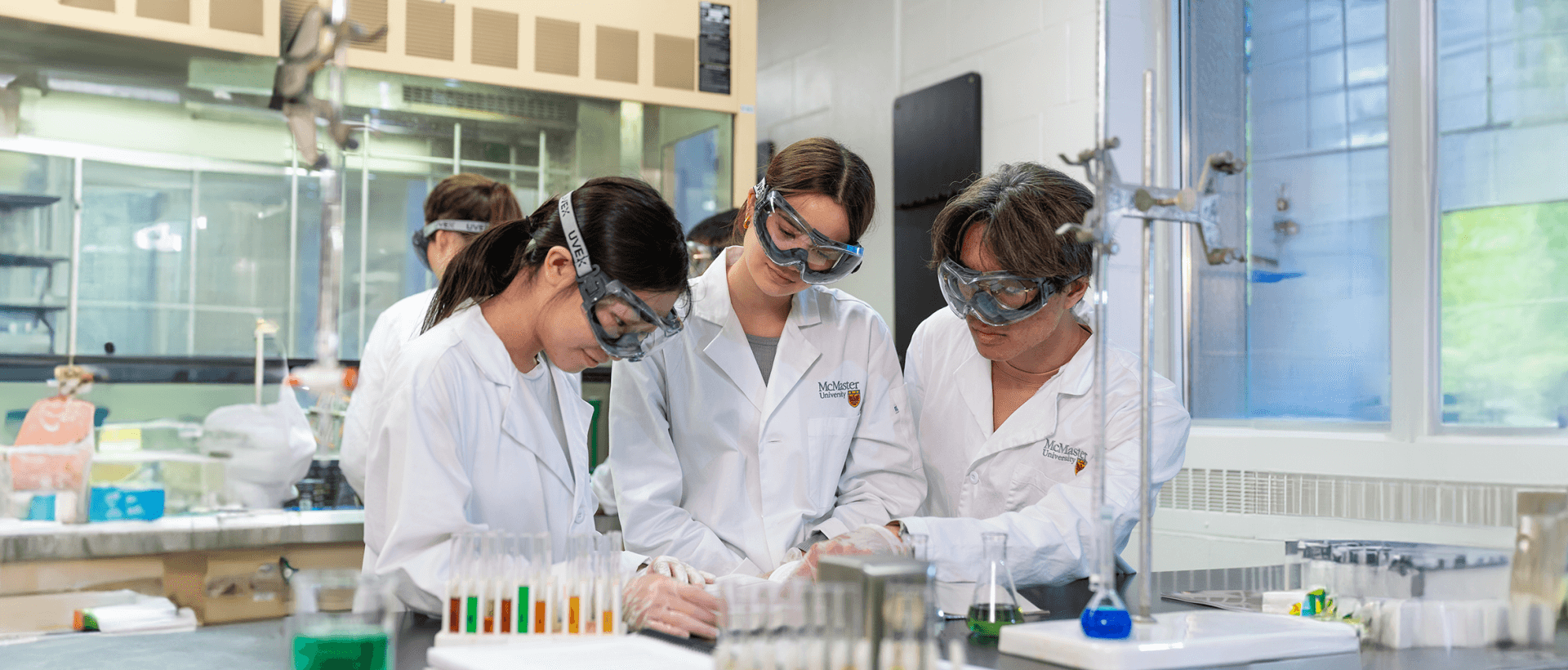
Everything we know is either matter or energy. Understanding how matter and energy behave and interact is critical to an understanding of the universe at every level, from the submicroscopic constituents of matter to the macroscopic behaviour of galaxies and star clusters. This understanding comes through a mix of mathematical description, computational modelling, and experimental investigations.
How the Chemical & Physical Sciences Gateway Works
You only spend one year in the Chemical & Physical Sciences Gateway before moving into a program/major. This foundational first year is great for narrowing down which area of science you are most interested in.
All programs (that begin in second year) have specific first year courses needed for progression. Complete courses in first year based on your interest and the requirements for the programs you are considering for second year.
At the end of first year, you will rank your programs of interest. We help you along the way! Admission to the programs that begins in second year is based on courses taken and a first-year minimum average.
Whether you know exactly what area of science you are interested in or are still undecided, the structure of our Chemical & PhysicalSciences Gateway will provide you with a range of program options across the science disciplines.
While some students continue in a Level II program from the same area of study as their Gateway, others discover a new area of interest and change their original direction.
Click an area of interest to learn more about the program options available to you.
Anticipated Admission Average
Target Enrolment
Experiential Education provides students with the opportunity to gain real-world, academically relevant experience in a community, research, or professional setting. Combining both academic and applied learning allows students to further develop skills and gain experience to transfer to future career paths. Students gain experience through: Applied Science Placement Courses, Research Practicum Courses, Science Internships.
Explore career opportunities while gaining relevant professional experience, and develop connections with employers from academia, industry, government, and hospital sectors. Cooperative Education is an integrated approach to higher education that enables highly motivated students to alternate academic terms with paid, relevant work experience. Review the following link to learn more about our co-op programs. Experience – Science Careers & Experience Centre – Faculty of Science – McMaster University
The Faculty of Science is thrilled to offer the Office of Undergraduate Research (OUR) at McMaster University, which is the first of its kind at an undergraduate level in Canada. The mission of the OUR is to promote excellence in undergraduate student and faculty-led, collaborative research and scholarship in all disciplines. We recognize that it is incumbent upon us as a Faculty to provide opportunities for an immersive research experience for all our undergraduate students.
The Faculty of Science is committed to student success! Whether you need support, have a question, or are feeling a little lost, our knowledgeable, friendly team is here to support your academic success during your undergraduate studies.
Complete Science courses in Level I that reflect your interest and the admission requirements of the Level II program(s) you are considering, complemented by electives. The following courses are what we typically see Chemical & Physical Sciences students take, but it is completely up to you!
Chemical & Physical Sciences at McMaster prepares students for a variety of careers in science and elsewhere by giving them a firm foundation in traditional scientific disciplines while exposing them to multidisciplinary approaches to solving pressing problems.
I of course use my knowledge of physics daily, but my degree also allowed me to learn valuable life lessons, like persistence, that I carry with me.
I recently graduated from the Honours Astrophysics program with a minor in French. Now I am doing my master’s degree in Astrophysics, also at McMaster, where I use computational techniques to study star formation.
I started in the Chemical & Physical Sciences Gateway program because I came into university with the plan of pursuing physics and becoming a teacher. I chose McMaster after visiting the campus in my grade 12 year and falling in love. The community, especially the people I talked to from the Faculty of Science, was incredibly supportive and welcoming, and the students I interacted with were genuinely happy and excited about their departments.
Pursuing physics at McMaster opened my eyes to the possibilities I had post-graduation, and eventually, my goals switched from wanting to be a teacher to wanting to stay in academia and become a professor. I also came into my own in the department, being given a space and the mentors to be able to pursue passions outside of physics, like equity efforts in STEM. Being a graduate student, I of course use my knowledge of physics daily, but my degree also allowed me to learn valuable life lessons, like persistence, that I carry with me.
If I could give any advice to a student interested in the Faculty of Science at McMaster, it would be: relax and remember that one mistake or uncertainty is not the be-all and end-all of your life or your aspirations. You can do this. Just breathe
Chemical & Physical Sciences Gateway students have an opportunity to participate in the many state-of-the-art labs and facilities throughout their undergraduate degree, beginning as early as their first week of classes. Explore some of these labs and facilities used daily by undergraduate students. Virtual Tours – McMaster Academic Planner (MAP) – Faculty of Science – McMaster University