-
Overview
Graduates are prepared to be professional nurses who will practice in a variety of health-care settings. Central to our mission is the preparation of nurses who will work to enhance the quality of health of individuals, families, communities and society.
McMaster’s current nursing curriculum uses a problem-based, small group, self-directed educational model. Students may complete their McMaster (BScN) degree at one of three sites:
- McMaster University
- Mohawk College
- Conestoga College
Applicants will be considered for admission to each institution to which they apply. Applicants interested in either Mohawk or Conestoga colleges must apply through the Ontario College Application Service (OCAS).
Students attend the institution to which they are admitted for the entire four years of the program. Transfer from the colleges to the university site is not an option. Similarly, transfer from McMaster University to the colleges is not an option. Students from all three institutions will graduate with a McMaster University Bachelor of Science in Nursing degree upon successful completion of the program.
Program Brochure
-
Admission Details
Admission Average & Requirements
OUAC Application Code: MN
Target Enrollment: 120 Students (McMaster Site)
Web Links


Why Nursing at McMaster?
McMaster Mohawk Conestoga B.Sc.N. Program
The School of Nursing provides high-quality, innovative nursing education in a unique educational setting. Our programs promote nursing as a caring, client-centred, scientifically-based profession. Our goal is to prepare you for practice in a wide variety of health care settings through curricula that are responsive to real world needs. Our Bachelor of Science in Nursing (B.Sc.N.) Program is delivered in partnership with Mohawk College and Conestoga College.
The School of Nursing pioneered problem-based learning (PBL) in nursing education and we continue to believe that this approach best prepares our students for the roles that they will hold after graduation. PBL involves small-group, self-directed learning that emphasizes interpersonal skills, independent learning, and leadership qualities. Learning is a process of inquiry, a skill to develop as a life-long activity in an environment conducive to openness and sharing between faculty and students. Emphasis on small-group tutorials and self-directed learning promotes the development of critical thinking abilities and self-evaluation skills. In addition to the professionals who will teach you throughout your time here at the School of Nursing, extensive multi media, laboratory and library resources support you in independent study. Students apply concepts from nursing and related disciplines to their experiences in classroom, laboratory, and clinical settings.
- The University Experience
There are many opportunities to get involved both in the activities of the School (such as MUNSS and MacSoc) and in the university itself. McMaster is committed to valuing cultural diversity and building an inclusive community in which students can learn and excel. - Research and Evidence-Based Practice
The School of Nursing strongly believes that the best nursing practice is based on scientific evidence. Our program gives you experience with the research process and teaches you to gather and critically evaluate research to promote critical thinking and problem solving skills. Evidence-based practice supports sound decision making and continuous learning. - Professional Nursing Practice
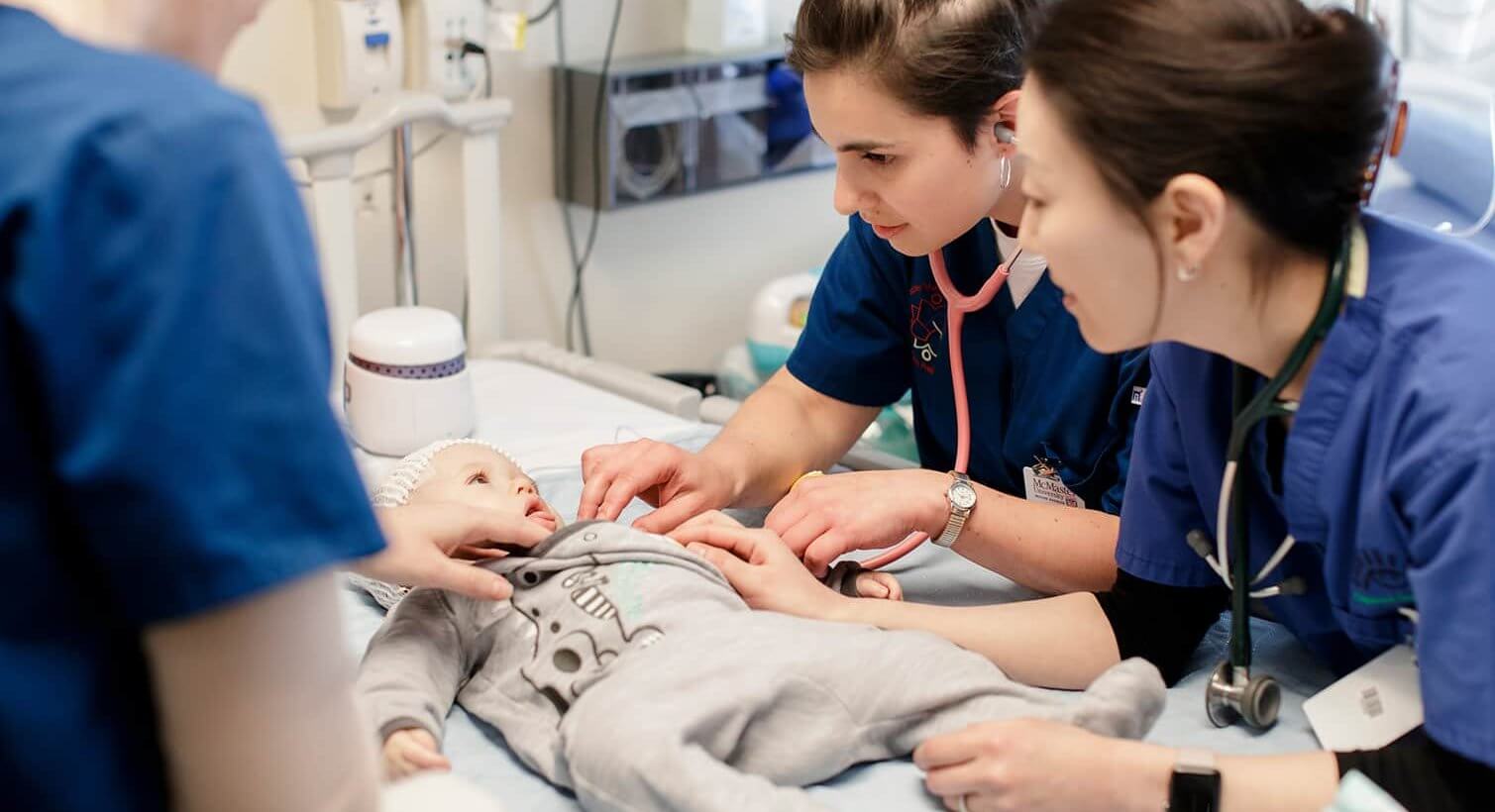
You will have many opportunities throughout your program to put theory into practice in clinical settings. Through our partnerships with a wide variety of hospitals, agencies, and community settings, you will experience multiple locations and specialties that will help you to decide what specialty is right for you. There are also exciting opportunities for nursing placements in outpost and international settings! Learn more about nursing placements.In our Clinical Learning Centre, you will have the opportunity to practice skills learned on simulation equipment and work with interprofessional student teams to solve healthcare scenarios. - Our Educational Methods
One of many advantages of Nursing at McMaster is the opportunity to get to know both your professors and your classmates well; most of the classes you will take will have no more than 12 participants. This provides a learning environment that prepares nurses to use leadership skills in nursing and with multidisciplinary health care teams.We believe that learning is a process of inquiry and collaboration in which the student and faculty tutor, as well as other clinical teachers, work toward a common goal or outcome. The process is student-centred and occurs through dialogue within a context of respectful relationship(s). To learn more about our educational methods, please click here.
-
1st Year Courses
The curriculum has been planned so that the study of nursing and its physiological, psychological, social sciences and humanities aspects are interrelated and span the entire program.
Level I provides the foundational knowledge for developing professional competence as a nurse.
Total = 30 units
Required: 27 units- Health Sciences 1BS0
- Health Sciences 1LL3
- Health Sciences 1H06
- Nursing 1A00
- Nursing 1F03
- Nursing 1G03
- Nursing 1I02
- Nursing 1J02
- Nursing 1K02
- Psychology 1X03
- Psychology 1XX3 (or 1N03, 1NN3 at Conestoga site only)
Elective: one 3 unit course of student’s choiceNote: The value of a particular course is indicated by the last digit of the course code (e.g. 1A03 = 3 units).
Beyond 1st Year
Bachelor of Science Nursing (BScN)
Since the BScN is a direct entry program, students are considered to be specializing/majoring in Nursing from first year to the end of the program. -
Careers or Options Beyond This Program
A Bachelor of Science in Nursing is the gateway to a profession that offers an astounding array of career tracks and opportunities. It provides graduates with more than just a job!
Registered Nurses practice independently or in teams with other health professionals to care for diverse clients across the lifespan. Nurses work in traditional settings in hospitals, nursing homes, public health and many more. They are present in a variety of areas such as pediatrics, emergency, maternity, psychiatry, palliative care or geriatrics to name a few. Nurses also work in non-traditional settings such as poison control centers, parishes, on the streets with homeless people, AIDS hospices or in a variety of other industries.
Careers that are available to Registered Nurses include:
- staff nurses in hospitals, nursing homes, visiting
- nursing agencies and public health departments
- case managers for community care access centres
- entrepreneurs owning and managing health/nursing care businesses
- researchers in nursing care, education and health care
- educators of individuals, families, communities and nursing students.
Profiles & Alumni
Student Testimonials

Program Statistics
Annual Enrollment:
McMaster Site: Approx. 120 students
Conestoga Site: Approx. 140 students
Mohawk Site: Approx. 156 students
Schedule

-
Facilities
Health Sciences Library
The Health Sciences Library is a recently renovated facility that meets the needs of the 21st century learning environment.
The focus of the design is on “people space” with a Learning Commons, an e-Classroom, study rooms, a reading pavilion and wireless access throughout.
Over 4000 online journals and 850 online books related to health sciences are available, in addition to the thousands of online resources in the other campus libraries. A nursing liaison librarian works with students to answer their learning and research needs.
Centre for Simulation Based Learning
Clinically-equipped examination rooms along with low and high fidelity simulation models give students the opportunity to practice nursing.The Centre has sophisticated audio visual equipment to monitor and record students as they practice their skills and receive feedback from peers and professors.
Standardized Patient Program
This program provides a learning opportunity to teach, assess and refine communication and clinical skills.A Simulated/Standardized Patient is a healthy, able-bodied person trained to portray the personality, history and emotions of an actual person in a specific situation in a realistic and reliable manner.
Anatomy Laboratory – A large number of pre-dissected specimens complimented by models, medical images and demonstrations are used to help learn about the structure of the human body.
-
Clinical Placements
In Level I students develop nursing skills for clinical practice in the Centre for Simulation Based Learning.In Levels II to IV, students gain knowledge and skills through direct patient care in both hospital and community settings.
Clinical practice helps students apply theory learned in the classroom and is an integral part of the program.
Placements in the local area include: four acute care hospitals (one right on campus), City of Hamilton – Social and Public Health Services, two visiting nursing agencies and several long term care facilities.
Our catchment area includes sites in Halton, Peel, Niagara and Brant regions. Depending on the accessibility of public transportation, students may need to rely on the use of a vehicle. Transportation to and from all clinical sites is the responsibility of the student.
Other opportunities for students’ practice may include:
- caring for children and adults in acute care medical or surgical settings
- maternal/child (maternity) mental health
- public health
- visiting nursing
- long term care
- primary health care
Level IV students may select a placement in a Canadian outpost, northern or international setting (students have traveled to Chile, England, Botswana, Alaska, Northern Ontario, the Northwest Territories, Newfoundland, British Columbia, Australia, Thailand and Columbia).
For more information, visit: http://fhs.mcmaster.ca/nursing/practice_globalhealth.html